
Agile, Scrum, and Support Need Different Terminology
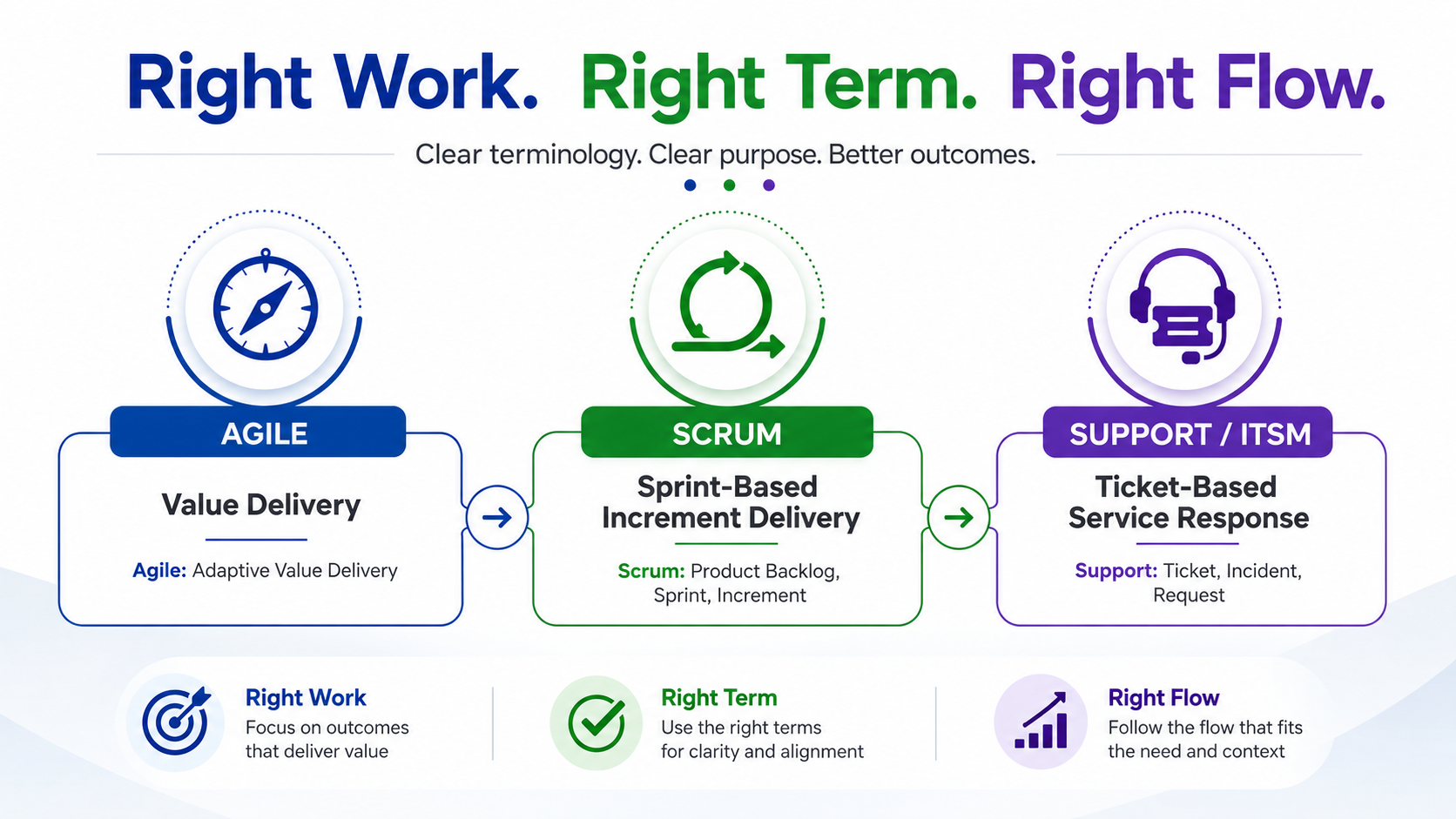
Many teams use the word ticket for different types of work: user stories, bugs, support requests, backlog items, incidents, technical tasks, or product improvements.
This is understandable because many tools make work items look similar. They appear on boards, have statuses, owners, comments, priorities, and history. Over time, it becomes easy to use one word for everything.
But terminology is not only wording. The words we use shape how teams understand the work, the flow, the responsibility, and the expected outcome.
This post is not about policing language or saying that the word ticket should never be used. It is about awareness.
Agile, Scrum, and support work are all important, but they do not represent the same type of work. Agile focuses on adaptive value delivery. Scrum gives teams a framework for delivering increments. Support work often focuses on requests, issues, incidents, restoration, and service expectations.
When everything becomes a ticket, teams may lose the difference between product delivery, backlog management, issue tracking, support work, and incident response.
Clear terminology helps teams communicate better, align expectations, measure the right outcomes, and build a healthier delivery culture.
Why Terminology Matters
Terminology matters because it creates shared understanding. When a team uses the same word for every type of work, communication may feel simpler at first, but the meaning becomes less clear.
A user story, a Product Backlog Item, a ticket, an issue, and an incident can all appear inside the same tool. They may all have an owner, status, priority, comments, and history. But they do not represent the same intent.
The problem is not the tool. The problem is when the tool container becomes the main language for the work itself.
Clear terminology helps teams answer basic questions more accurately:
- What type of work is this?
- Who owns it?
- What outcome is expected?
- How should it be prioritized?
- How should success be measured?
- Does it need delivery, investigation, support, restoration, or prevention?
This is why terminology affects more than documentation. It affects planning, ownership, measurement, reporting, and culture.
Agile Is About Value Delivery
Agile is not a ticket-management method. It is a mindset based on adaptive planning, collaboration, feedback, and delivering value in small useful steps.
The main focus is not simply moving work items across a board. The focus is learning from feedback, responding to change, and helping teams deliver outcomes that matter to users and the business.
This is why the language matters. When Agile work is reduced to “tickets,” the conversation can become too focused on volume, status, and closure instead of value, learning, and impact.
A better question is not only:
How many tickets did we close?
A better question is:
What value did we deliver, and what did we learn from it?
Scrum Is a Delivery Framework
Scrum is not the same thing as Agile, and it is not just a board full of tickets. Scrum is a framework that helps teams deliver value through clear accountabilities, events, artifacts, inspection, and adaptation.
In Scrum, the Product Backlog is not simply a list of tickets. It is an ordered list of work that represents what may improve the product. The team uses it to decide what is valuable, what should be refined, and what can be selected for a Sprint.
This is where Product Backlog Items become important. A PBI can be a user story, bug, feature, technical improvement, spike, experiment, or any other work that may improve the product.
The goal is not only to complete items. The goal is to create a useful Increment that moves the product forward.
User Stories and PBIs Are Not Just Tickets
A User Story is a way to describe a user need and the value expected from meeting that need. It helps the team talk about who needs something, why they need it, and what outcome matters.
A Product Backlog Item is broader. It is any item in the Product Backlog that may improve the product. A PBI might be a user story, bug, feature, technical improvement, spike, experiment, or research item.
A ticket may be the tool container used to track the work, but it does not always describe the meaning of the work. The same tool can store a user story, bug, incident, support request, or improvement idea.
That is why calling everything a ticket can reduce clarity. It hides the difference between value discovery, product improvement, technical investigation, support response, and operational restoration.
Tickets, Issues, and Incidents Have Different Meanings
A ticket is usually a tracking container inside a tool. It can help record the request, owner, status, priority, comments, and history. That makes it useful, but it does not always explain the real nature of the work.
An issue usually means something needs attention, investigation, fixing, or resolution. It may be related to a product defect, technical problem, process gap, or something that blocks progress.
An incident is different again. An incident usually means there is a live service disruption or operational impact that needs response, restoration, communication, and prevention of recurrence.
This is why the same board or tool can hold different types of work, but the team still needs clear terminology. A support request, a product bug, a user story, and a production incident should not always be understood or managed in the same way.
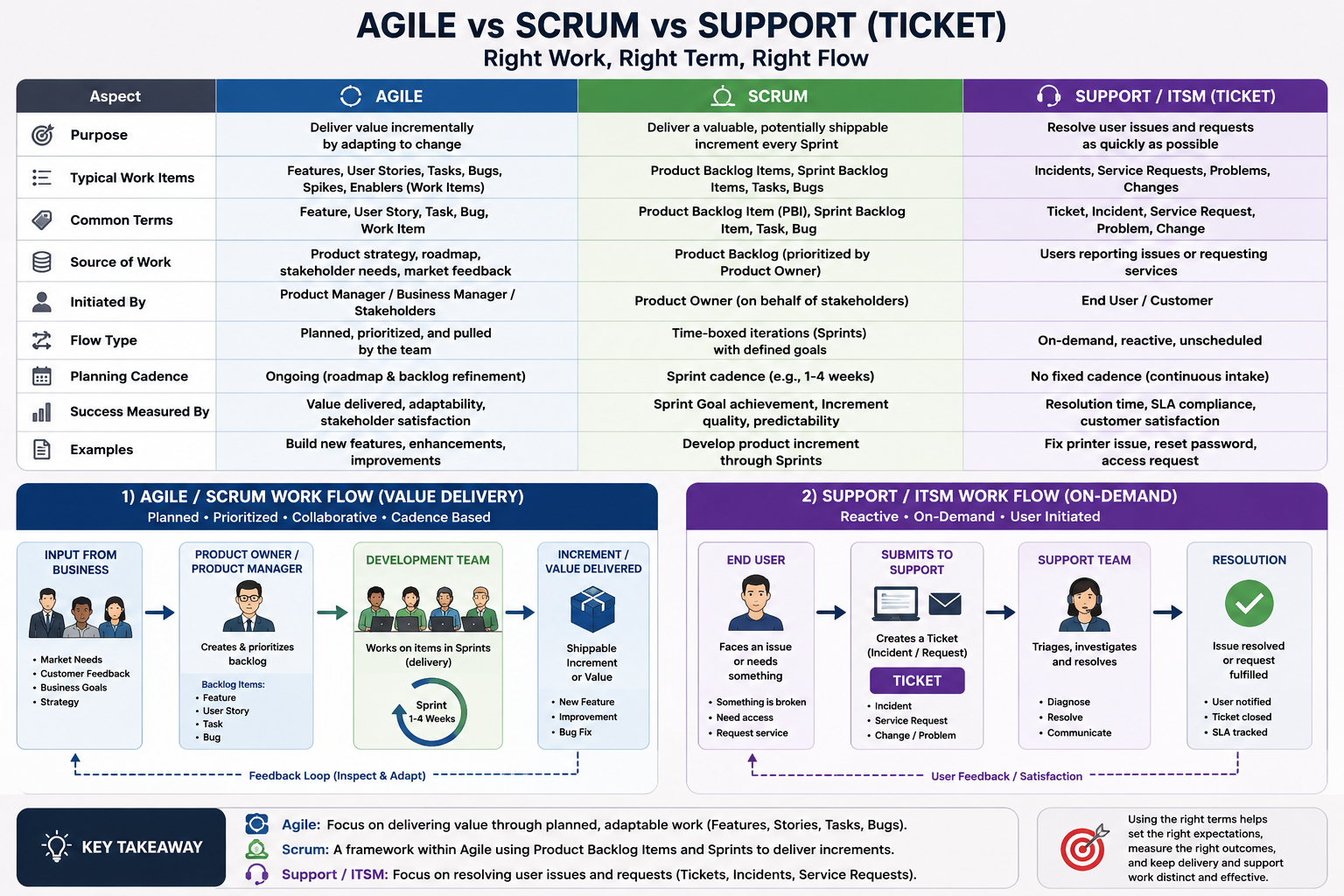
Visual Comparison
The following visual summarizes the difference between Agile, Scrum, User Stories, Product Backlog Items, Tickets, Issues, and Incidents.
It is not about deciding that one term is better than another. It is about using the right term for the right type of work, so teams can keep product delivery, backlog management, issue tracking, support work, and incident response clear.
Better Taxonomy, Better Culture
The goal is not to force people to use perfect terminology all the time. The goal is to create enough shared language so teams can understand the type of work in front of them and manage it in the right way.
A healthy taxonomy helps teams separate product discovery from product delivery, backlog refinement from issue tracking, and service response from incident management.
This improves communication because people are not guessing what a work item means. It improves ownership because different types of work may need different roles, workflows, priorities, and success measures.
It also protects culture. When everything is treated as a ticket to close, teams may become focused on throughput instead of value, learning, reliability, and customer impact.
Better terminology does not need to become language policing. It should help teams build a shared operating model that makes work clearer, not heavier.
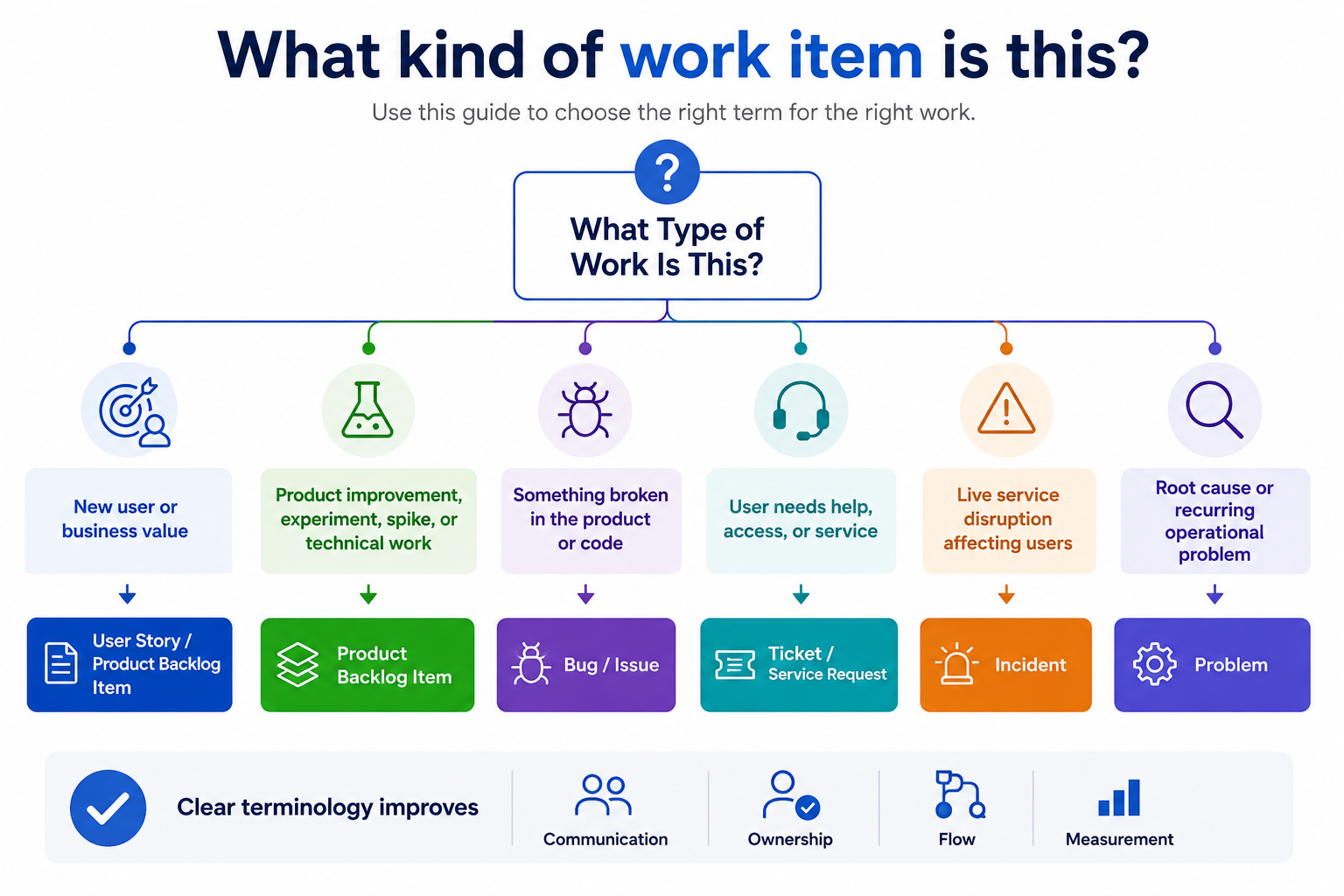
What Kind of Work Is This?
A simple way to improve terminology is to ask what kind of work the item actually represents before naming it.
If the work describes a user need or business value, it may be a User Story or another type of Product Backlog Item. If it represents product improvement, technical learning, or discovery, it may also belong in the Product Backlog.
If something is broken, unclear, blocked, or needs investigation, it may be an Issue. If a user needs help, access, or service, it may be a Ticket or Service Request. If a live service is disrupted and users are affected, it is closer to an Incident.
The point is not to create a complicated naming system. The point is to make the nature of the work visible before the team decides how to prioritize, route, measure, and resolve it.
Final Thought
The word ticket is not the problem by itself. Tickets are useful when the work is mainly about tracking, routing, ownership, and resolution.
The problem starts when every type of work is treated as the same thing.
Agile, Scrum, product delivery, issue tracking, support requests, and incident response all need clarity. They may use similar tools, but they do not always have the same purpose, workflow, ownership model, or success measure.
Better terminology helps teams protect that clarity. It supports better communication, better expectations, better measurement, and a healthier delivery culture.
The goal is not strict language policing. The goal is simple: use the right term for the right work, so teams can deliver value, resolve problems, and support users with more clarity.